Backtofrontshow Pricing: A Complete Guide to Costs, Plans, and Value
Understanding backtofrontshow pricing is an important first step for anyone researching the platform, comparing its features, or deciding whether it offers good value for money. Pricing information can influence whether a service fits an individual budget, meets a business requirement, or provides enough benefits to justify a recurring payment. However, making an informed decision requires more than looking at a single price. It also involves understanding the available features, possible subscription arrangements, payment terms, and any additional charges that could affect the overall cost.
When researching an online service, it is sensible to distinguish between verified pricing information and assumptions based on similar platforms. Prices can change, subscription options may be updated, and some services provide different terms depending on the intended use. For that reason, this guide explains how to evaluate the available information, identify the factors that influence the total cost, and determine whether the service represents suitable value. It does not present unverified prices as official figures.
Whether someone has discovered Backtofrontshow through a search engine, a recommendation, or an online discussion, a clear understanding of pricing can make the decision process much easier. By examining the important details before committing financially, prospective users can avoid unexpected expenses and make a choice based on practical needs rather than assumptions.
What Is Backtofrontshow and Why Does Pricing Matter?
Before evaluating the cost of any online service, it is useful to establish what the service actually offers. The name Backtofrontshow alone does not establish its exact business model, feature set, or subscription structure. Without a verified official description, it would be misleading to claim that it provides particular tools, memberships, entertainment features, or professional services.
This distinction matters because the right pricing comparison depends on the type of service involved. A subscription-based website, a digital entertainment platform, a professional service, and a membership community can all use different payment models. Each model has its own advantages, limitations, and potential expenses. Understanding the service’s purpose is therefore essential before deciding whether its cost is reasonable.
Pricing matters because it establishes the relationship between what a customer pays and what they receive. A low advertised fee might appear attractive, but it may not include every feature or benefit that a user expects. A higher price may be justified when it includes valuable services, better support, or more flexible access. The important consideration is the overall benefit rather than the headline amount alone.
A careful assessment of Backtofrontshow should begin with reliable information about its official offering, followed by a review of the current payment terms. This approach provides a stronger foundation for evaluating affordability, transparency, and long-term value.
Current Backtofrontshow Pricing and Advertised Plans
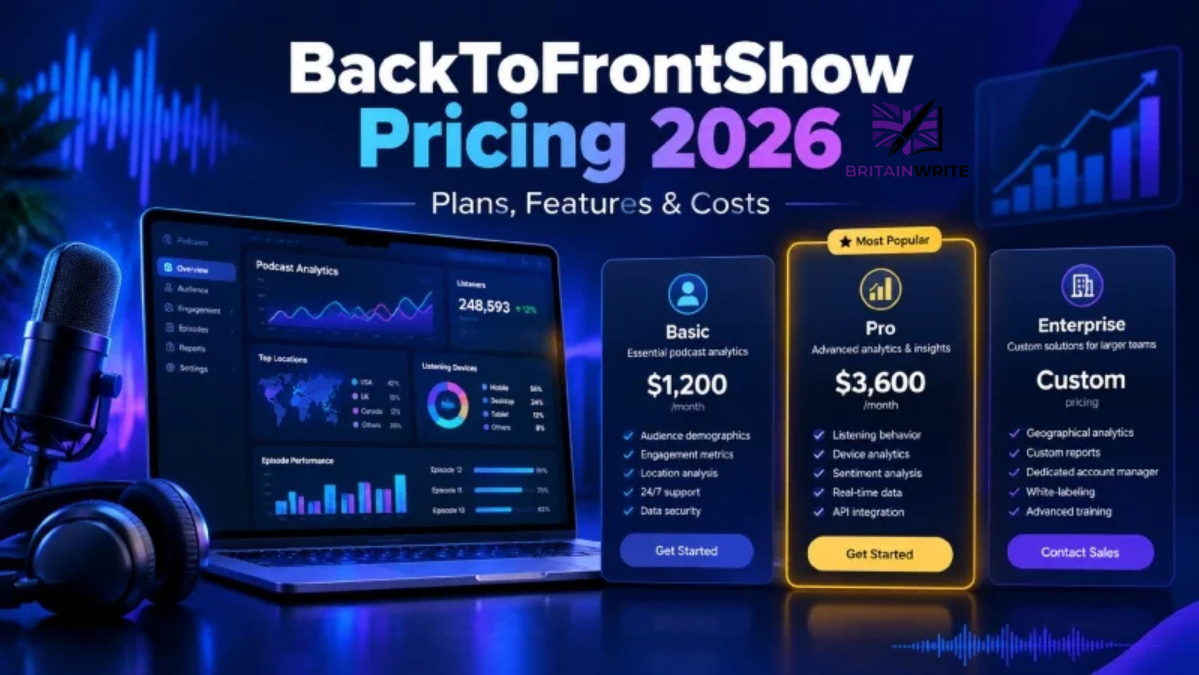
The official website at BacktoFrontShow.com presents the service as a podcast analytics platform designed to help creators and media teams understand their audiences. Its pricing section advertises a Basic plan at $1,200 per month, a Pro plan at $3,600 per month, and an Enterprise option with pricing available on request. These are the figures displayed on the website, but prospective customers should confirm the current terms directly with the provider before making a purchase.
The advertised amounts are substantial, particularly for independent podcasters and small creative businesses. Rather than assuming that the plans are suitable for everyone, potential customers should examine the features included, the expected return on investment, and the availability of a working demonstration. Published prices alone do not establish whether a service is reliable, whether every advertised feature is operational, or whether the investment will produce meaningful results.
The following table summarises the publicly advertised plans and the information available about them.
| Plan | Advertised price | Listed features or benefits |
|---|---|---|
| Basic | $1,200 per month | Listener demographics, episode performance, listening trends and customised reporting |
| Pro | $3,600 per month | Basic features plus audience growth and churn analysis, segmentation and engagement metrics |
| Enterprise | Available on request | Predictive analytics, marketing and CRM integrations, user behaviour tracking and additional reporting capabilities |
Source: The public BacktoFrontShow.com pricing page. Prices and features should be reconfirmed with the provider before purchase.
These advertised plans suggest that the service is positioned towards organisations seeking advanced podcast audience analytics rather than casual listeners looking for free entertainment. However, the website’s presentation should not be treated as independent proof of the platform’s performance, customer base, or commercial track record. A sensible purchasing decision requires additional verification.
What Does the Basic Plan Include?
The Basic plan is advertised at $1,200 per month and includes listener demographic analysis, episode performance tracking, listening trends, customisable reports, feedback and interaction analysis, and accessibility and compliance features. According to the website, these capabilities are intended to provide a more detailed picture of podcast performance than download totals alone.
In practical terms, demographic analysis could help a podcast team understand its audience composition, while episode performance tracking could help identify content that attracts more attention. Listening trends may reveal changes in audience activity over time, and reporting tools could help organise those findings for marketing or editorial decisions. The usefulness of these features depends on the quality and availability of the underlying data.
The key consideration is whether these capabilities solve a genuine business problem. An independent creator who publishes one episode each week may not need an expensive analytics package if their existing hosting provider already supplies useful download statistics and audience information. A media company managing multiple programmes, on the other hand, may have more complicated reporting requirements.
Before paying for the Basic plan, a prospective customer should request a demonstration using realistic examples. It is also important to establish which data sources are supported, how often information is updated, and whether the reports provide insights that cannot be obtained through existing tools.
Understanding the Pro Plan and Its Additional Features
The Pro plan is advertised at $3,600 per month, making it three times the published monthly price of the Basic option. The website lists audience growth and churn analysis, segmentation and targeting, engagement metrics, and the features included in the lower-priced plan.
Audience growth analysis could be useful for identifying changes in listener numbers, while churn analysis may help a team investigate whether its audience is declining or becoming less engaged. Segmentation can also support more focused marketing by grouping listeners according to relevant characteristics, provided the platform has suitable data and permissions.
However, more features do not automatically make a higher-priced plan better. The additional cost needs to be justified by measurable improvements in reporting efficiency, audience development, advertising decisions, or other business outcomes. If the Pro plan saves a team only a small amount of time or produces insights that do not influence its strategy, the financial case may be weak.
A practical evaluation should compare the Pro plan with the Basic plan on a feature-by-feature basis. Ask for examples of the additional reports, demonstrations of segmentation tools, and a clear explanation of how audience growth and churn are calculated. These details make it easier to judge whether the higher price provides enough additional value.
Enterprise Pricing and Custom Solutions
The Enterprise option is advertised without a fixed public price. Instead, interested organisations are directed towards the provider for a customised quotation. The listed features include predictive analytics, integrations with marketing and customer relationship management tools, customised reporting, user behaviour tracking, and accessibility and compliance capabilities.
Custom pricing is common in business software because large organisations can have different requirements for data volume, integrations, reporting, security, and technical support. A media network operating several podcast brands may need a different configuration from an agency managing campaigns for a small number of clients.
Nevertheless, a custom quote should provide more than a single monthly figure. It should explain what the customer receives, how many accounts or podcast feeds are supported, which integrations are included, and whether implementation or onboarding fees apply. The agreement should also clarify service availability, support response times, data retention, and cancellation conditions.
For organisations considering an Enterprise agreement, it is particularly important to establish whether predictive analytics and integrations are available as working features or require additional development. A written proposal and a practical demonstration can help prevent misunderstandings about what the contract actually covers.
What Influences the Total Cost?
The advertised subscription price is only one part of the financial picture. The total cost of a digital analytics service may also depend on setup requirements, integration work, staff training, data migration, additional accounts, and support arrangements. Not every provider charges separately for these items, so they should be verified rather than assumed.
Subscription duration can also affect affordability. A monthly agreement may provide flexibility, while an annual commitment can involve a substantial upfront payment. If a provider offers a discount for longer commitments, the customer should compare the savings with the risk of paying for a service that does not meet expectations.
When evaluating backtofrontshow pricing, it is worth requesting a complete written breakdown of the charges. This should identify the recurring subscription fee, any one-time costs, applicable taxes, renewal terms, and the procedure for ending the agreement. The aim is to calculate the actual cost of using the service, not simply the advertised entry price.
| Cost consideration | What to verify | Why it matters |
|---|---|---|
| Monthly subscription | Exact amount and billing currency | Establishes the recurring expense |
| Setup and onboarding | Whether implementation is included | Helps identify initial costs |
| Integrations | Included connections and any extra fees | Prevents unexpected technical expenses |
| User or account limits | Number of users and podcast feeds supported | Reveals potential expansion costs |
| Support | Included assistance and response commitments | Clarifies the level of service |
| Renewal and cancellation | Contract length and notice period | Reduces the risk of unwanted charges |
| Taxes and payment fees | Applicable charges and payment conditions | Helps establish the final payable amount |
This checklist is useful because pricing transparency is about more than displaying a number. Customers should understand the complete commercial arrangement before providing payment details or signing a contract.
Is Backtofrontshow Pricing Worth the Money?
Whether a service is worth its price depends on the results it can realistically deliver. For a podcast network with several shows, a large audience, and a dedicated marketing team, detailed analytics may support better content planning, audience segmentation, and advertising decisions. Those benefits could justify a substantial subscription if they can be demonstrated and measured.
For a small independent creator, the same subscription could represent an unnecessarily large expense. Many podcast hosting services and analytics tools provide basic episode statistics, listening trends, and audience information at considerably lower cost or as part of an existing subscription. Comparing those alternatives can help determine whether advanced reporting would make a meaningful difference.
A useful principle is that the value of analytics comes from better decisions, not simply from collecting more data. A dashboard containing dozens of charts is of limited benefit if the information does not help a creator understand performance or improve future episodes.
The best evaluation is therefore based on a defined objective. This might involve reducing reporting time, identifying high-performing episodes, improving audience retention, or producing clearer reports for advertisers. Before subscribing, establish how success will be measured and which features are necessary to achieve it.
How to Calculate the Return on Investment
Return on investment, commonly abbreviated as ROI, provides a way to compare the financial benefit of a service with its cost. For an analytics platform, the calculation should include measurable gains such as additional revenue, demonstrable cost savings, or reduced staff time. Potential benefits should not be counted as guaranteed income.
For example, a business paying $1,200 per month would spend $14,400 over twelve months if the price remained unchanged and no additional charges applied. At $3,600 per month, the equivalent annual subscription cost would be $43,200. These calculations exclude taxes, setup expenses, discounts, and any future price changes.
The following example illustrates how a business might evaluate a subscription.
| Financial measure | Basic example | Pro example |
|---|---|---|
| Monthly advertised fee | $1,200 | $3,600 |
| Annual subscription cost | $14,400 | $43,200 |
| Illustrative monthly measurable benefit | $1,800 | $5,000 |
| Illustrative annual measurable benefit | $21,600 | $60,000 |
| Annual benefit minus subscription cost | $7,200 | $16,800 |
These benefit figures are hypothetical examples, not claims about actual BacktoFrontShow results. They assume unchanged monthly prices and exclude other expenses.
Under this illustration, both plans would produce a positive difference between the assumed benefits and subscription costs. However, the outcome would change if the service generated smaller benefits or required additional expenditure. Businesses should use their own figures rather than relying on optimistic estimates.
The calculation also needs to distinguish between revenue and profit. An increase in advertising revenue does not necessarily translate into an equal increase in profit because campaigns, production, staffing, and other activities have their own costs. A realistic financial assessment includes those expenses.
Comparing BacktoFrontShow With Alternative Analytics Tools
Before committing to a high-cost analytics platform, prospective users should compare its advertised capabilities with those of other services. The objective is not necessarily to find the cheapest product but to identify the tool that meets the organisation’s needs at a reasonable total cost.
Podcast hosting dashboards are a sensible starting point because they may already provide episode downloads, listening trends, and other standard measurements. Specialist analytics tools may offer additional reporting or integration capabilities, while broader marketing platforms can connect podcast performance with campaign and customer data. The right comparison depends on the questions the team needs to answer.
A fair assessment should use the same criteria for every product. These include supported podcast platforms, metric definitions, reporting flexibility, integration options, data privacy, customer support, and the reliability of the information supplied. Current pricing should be checked directly with each provider because plans and included features can change.
It is also important to consider the practical cost of switching. A cheaper alternative may require staff training or manual reporting, while a more expensive product may save time if it integrates effectively with existing systems. These differences should be included in the overall evaluation.
How to Verify the Platform Before Paying
An unfamiliar service deserves careful checking, especially when its advertised plans involve thousands of dollars per month. The first step is to confirm that the website belongs to the intended provider and that the commercial terms are available from an official source. A search result or third-party article is not a substitute for a direct quotation or written agreement.
The next step is to request a demonstration and ask for evidence that the advertised features work as described. A demonstration should show the actual dashboard, supported integrations, report generation process, and the way metrics are defined. If the service is intended for professional use, it is reasonable to request documentation explaining its technical requirements and data-handling practices.
Customer references can provide additional reassurance, although they should be independently checked where possible. Claims about customer satisfaction, audience growth, or performance improvements should be supported by clear evidence rather than marketing language alone. A professional-looking website does not, by itself, establish that a service is suitable or commercially reliable.
Finally, review the agreement before paying. Confirm the identity of the contracting business, payment recipient, renewal conditions, cancellation policy, refund terms, and any limitations on data access. If these details are unclear or the provider is unwilling to explain them, postponing the purchase is a prudent decision.
Common Mistakes to Avoid When Evaluating Pricing
One frequent mistake is assuming that a published price represents the entire cost of ownership. A subscription may be accompanied by implementation work, additional accounts, or other expenses. Even when the advertised amount is accurate, the final cost can differ depending on the contract and the customer’s requirements.
Another mistake is paying for advanced features simply because they sound impressive. Predictive analytics, audience segmentation, and custom reporting can be useful, but their value depends on the quality of the underlying data and the ability to turn the results into practical decisions. Features that a team never uses provide little financial benefit.
It is equally important not to confuse advertised capabilities with independently verified performance. A provider may describe what its software is designed to do, but that does not automatically establish the accuracy of its measurements or the effectiveness of its recommendations. A demonstration, written documentation, and clearly defined evaluation criteria help close that gap.
The final mistake is committing to a long contract without understanding the exit terms. Even a suitable product can become less useful as business needs change. Flexible terms, clear cancellation procedures, and reliable access to exported data can make a significant difference to the overall purchasing decision.
Frequently Asked Questions
How much does Backtofrontshow cost per month?
The public BacktoFrontShow.com website advertises a Basic plan at $1,200 per month and a Pro plan at $3,600 per month, with Enterprise pricing available on request. These are published figures rather than independently verified proof of a fully operational service or a guaranteed final charge. Prospective customers should confirm the current price, included features, and contract conditions directly with the provider.
Does Backtofrontshow offer a free plan?
The public pricing page lists paid Basic and Pro plans alongside a custom-priced Enterprise option. It invites visitors to request access or arrange a demonstration, but it does not clearly establish a permanent free subscription. Anyone considering the service should ask the provider whether a free trial, limited evaluation account, or demonstration environment is available and whether any conditions apply.
What is included in the Basic plan?
The advertised Basic plan includes listener demographic analysis, episode performance tracking, listening trends, customisable reporting, feedback and interaction analysis, and accessibility and compliance features. The practical usefulness of these capabilities depends on the data available and how the tools operate. A demonstration can help confirm the scope of the features before a purchasing decision is made.
What is the difference between the Basic and Pro plans?
The website advertises audience growth and churn analysis, segmentation and targeting, and engagement metrics as additional Pro capabilities. The published monthly fee is $3,600 for Pro compared with $1,200 for Basic. This means the advertised Pro subscription costs three times as much, so customers should establish whether the extra analytical capabilities justify the difference for their particular workload.
Is Backtofrontshow pricing suitable for independent podcasters?
The advertised prices may be difficult to justify for independent creators with limited budgets, especially when basic analytics are already available through podcast hosting services. However, suitability depends on the creator’s audience, business model, reporting needs, and potential financial return. A small creator should compare alternatives and establish a measurable benefit before considering an expensive subscription.
Does Backtofrontshow offer custom Enterprise pricing?
Yes. The public website lists an Enterprise plan with pricing available on request. Its advertised capabilities include predictive analytics, marketing and CRM integrations, customised reporting, and user behaviour tracking. Organisations interested in this tier should request a written proposal covering the subscription fee, implementation costs, supported integrations, service commitments, and contract duration.
Are the advertised prices independently verified?
The figures can be checked against the provider’s public pricing page, but the presence of a price list does not independently verify the service’s performance, customer base, or commercial reliability. Buyers should request a live demonstration, confirm the contracting entity, review technical documentation, and obtain written confirmation of all fees before paying. These checks are particularly important when the proposed commitment represents a substantial business expense.
Can Backtofrontshow improve podcast audience growth?
The website advertises analytics intended to help users understand listener demographics, engagement, episode performance, and audience trends. Such information can support better content and marketing decisions, but analytics alone cannot guarantee audience growth. Results depend on content quality, promotion, consistency, audience demand, and the team’s ability to act on the findings. Any performance claims should be supported by evidence relevant to the customer’s own objectives.
Conclusion
Understanding backtofrontshow pricing requires more than comparing the advertised monthly fees. The public website lists Basic at $1,200 per month, Pro at $3,600 per month, and Enterprise pricing on request. It also describes podcast analytics features covering audience demographics, listening trends, engagement, reporting, and more advanced business insights. These details provide a starting point for research, but they should not be treated as a substitute for independent verification and a clear commercial agreement.
For businesses considering the service, the most important steps are to confirm the current prices, test the advertised features, compare competing tools, and calculate the potential return on investment. A suitable analytics platform should solve identifiable problems, provide reliable information, and justify its cost through measurable benefits.
Ultimately, the right purchasing decision depends on transparency, practical usefulness, and affordability. By verifying the provider’s claims and understanding the full contractual commitment before paying, prospective customers can make a more informed decision and reduce the risk of spending money on a service that does not meet their needs.
Read also Newanonib Understanding the Platform Online Privacy Digital Safety and Anonymous Communities